
At Etsy, our long-standing House Rules are the policy framework that enable us to keep our marketplace safe and special. Following these policies is a responsibility shared by our entire global community of buyers and sellers. That’s why it's important for everyone to understand what is and is not allowed on our marketplace, along with how we ensure consistent policy enforcement, measure success, and make improvements that benefit the community as a whole.
Read on to learn why policies exist on Etsy, explore key policy areas, and take a closer look at how we develop and evolve our policies over time.
Why policies exist on Etsy
Etsy is the home for creativity and self expression, and we’re committed to keeping Etsy special by elevating original items from real people, and providing a trusted ecosystem where creativity can thrive.
An important part of upholding our commitment is crafting policies that foster safe and inclusive human interactions, meet legal standards, and adapt to ever-changing societal norms and events.
Our policies are designed to protect all of our users—and Etsy—so we can continue to be a trusted marketplace. They’re intended to create an experience that makes both sellers and buyers want to use the platform, and promote positive outcomes for everyone on Etsy.
Types of policies
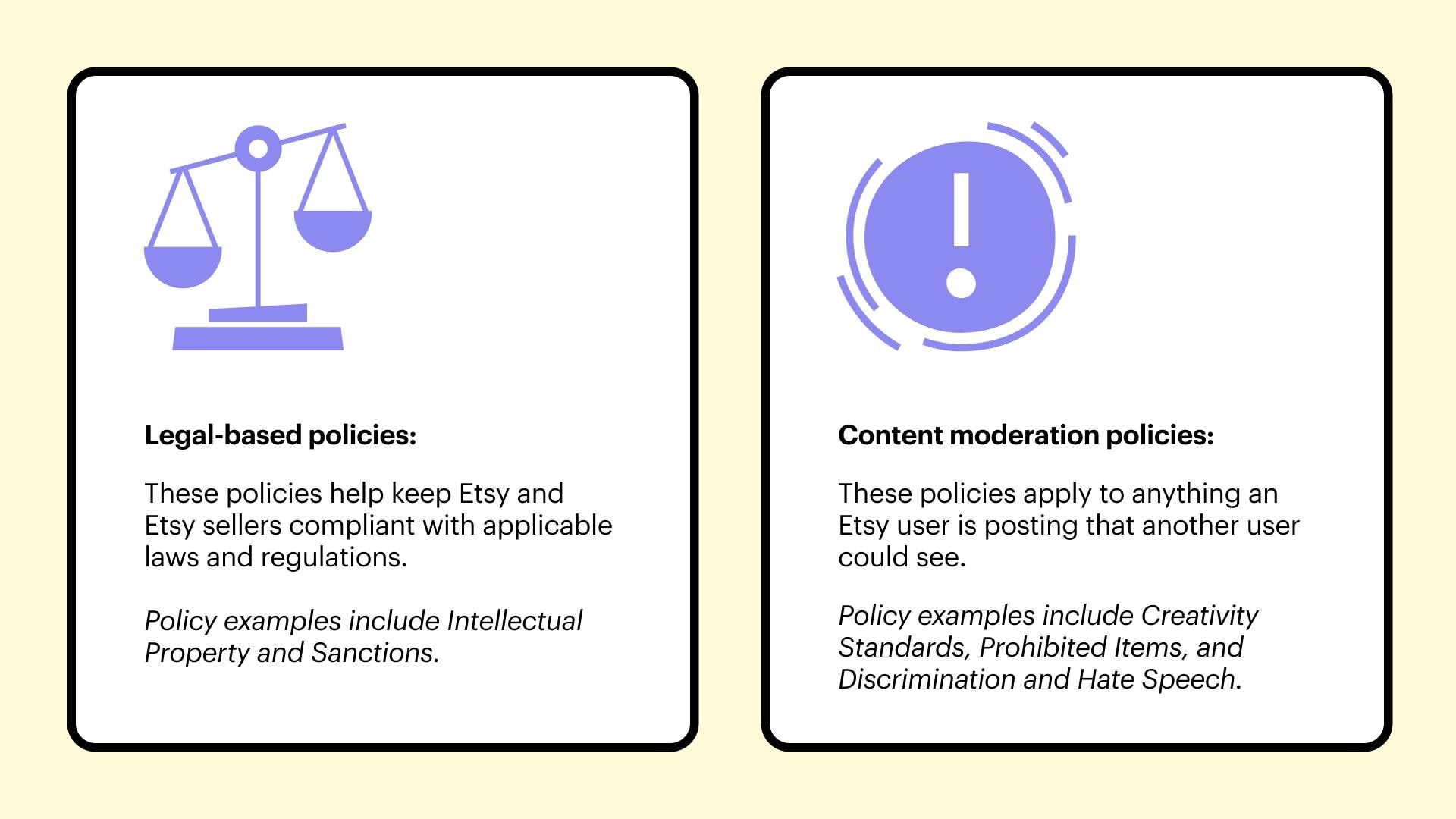
While policies often serve multiple purposes, it can be helpful to think about them in two broader categories:
Legal-based policies: These policies help keep Etsy and Etsy sellers compliant with applicable laws and regulations. Since different jurisdictions may have different requirements, it’s important for you as a seller to learn about and follow the laws applicable to your products, product listings, and where you offer your items, in addition to reading and following Etsy’s policies.
Policy examples include Intellectual Property and Sanctions.
Content moderation policies: These policies apply to anything an Etsy user is posting that another user could see—including the listings in your shop, posts in the Etsy Forums, direct messages exchanged between members, or details shared in your about section.
We work to remove harmful and fraudulent content from the platform so our entire community can feel safe buying and selling on Etsy. Our content moderation policies also ensure the items sold on Etsy align with our brand mission by connecting buyers with unique items made, designed, handpicked, or sourced by creative sellers around the world. To support this goal, we require sellers to accurately represent their items with clear listing photos and descriptions, and the addition of production partners when applicable.
Policy examples include Creativity Standards, Prohibited Items, and Discrimination and Hate Speech.
Spotlight on Creativity Standards
Buyers and sellers consistently ask us to reinforce what we stand for and show why Etsy—and every item you sell—is different and special. Our Creativity Standards outline clear guidelines for what belongs on Etsy, and what doesn’t. There are over 100 million listings on Etsy, created by ~5.6 million sellers, so identifying and removing items that don’t belong takes both human expertise and powerful tools. We’ve invested in automated detection systems and teams of people with deep expertise in identifying violative items so Etsy can remain a destination for one-of-a-kind and handcrafted goods.
How policies are created and developed
Crafting policies that foster safe and inclusive interactions, meet legal standards, and adapt to ever-changing societal norms and events is a bit like knitting a complex pattern: it requires skill, care, and willingness to continually reassess and reevaluate if all threads are aligned. Our policies aim to strike a balance between encouraging creative expression and safeguarding the trust and integrity of our marketplace.
To achieve this in practice, we guide our policy work by a set of consistent core values:
- Informed decision making: We engage with consultants who are experts in their fields to help us develop policies that are fair, relevant and responsive to the world we live in. A few recent examples include our policies regarding supplements and medical claims. In addition, we allocate resources to ensure ongoing compliance with evolving laws and regulations.
- Mitigate bias: We use a distinct set of principles to help root out bias from the policy decision-making process, including stakeholder input, creative expression, and clear and objective rules.
- Contextual consideration: We consider the context in which language or visual elements are used in our marketplace, as these factors can influence their meaning and the impact on our community. For example, if a seller uses potentially offensive language in a self-referential or reclaimed manner, we may treat it differently than if the same language is directed at another user in a disparaging way.
- Anticipate risks: We strive to proactively anticipate future challenges and monitor emerging trends, ensuring that our policies remain adaptive and forward-thinking.
- Commitment to iteration: We recognize that our work is never perfect or complete and commit ourselves to thoughtful, data-driven improvement.
These guidelines enable us to enforce policies consistently, protect our community from harm, and prevent future risk.
Staying responsive to shifting contexts
While the structured approach outlined above generally allows for clear decision making, we live in an ever-changing and increasingly-complex world. Some topics of online content moderation are highly nuanced, lack a clear consensus from third-party experts, and might have different meanings for different people.
In these cases, our team looks at industry best practices, emerging guidance, and the possibility for content to cause real-world harm in order to make the most informed decision with the data available to us.
We know we may not always get it right, and we're committed to monitoring new information and contextual changes so we can stay agile and reevaluate our policies when necessary.
How policies are enforced
When you open a shop on Etsy, you commit to following our Terms of Use and House Rules, including our Seller Policy, which outlines what can be sold on Etsy and our customer service standards.
We expect every user to follow our policies to ensure that Etsy remains a marketplace where creativity and originality thrive. We’re actively working to reduce how frequently shoppers see items that violate our policies to ensure they’re consistently experiencing the magic of Etsy—one-of-a-kind and handcrafted goods.
Our Trust and Safety team is dedicated to detecting potential content violations and enforcing our policies when items or member accounts are flagged for violations. This includes actions like listing mass-produced or resold items that violate our Creativity Standards or attempting to sell items that we don’t allow under our Prohibited Items Policy.
Our team uses a combination of automated systems and human review by policy specialists to monitor for, identify, and remove policy-violating listings and shops. Flags from our community members using our on-site tools, as well as flags from trusted authorities are also an integral part of our Trust and Safety process.
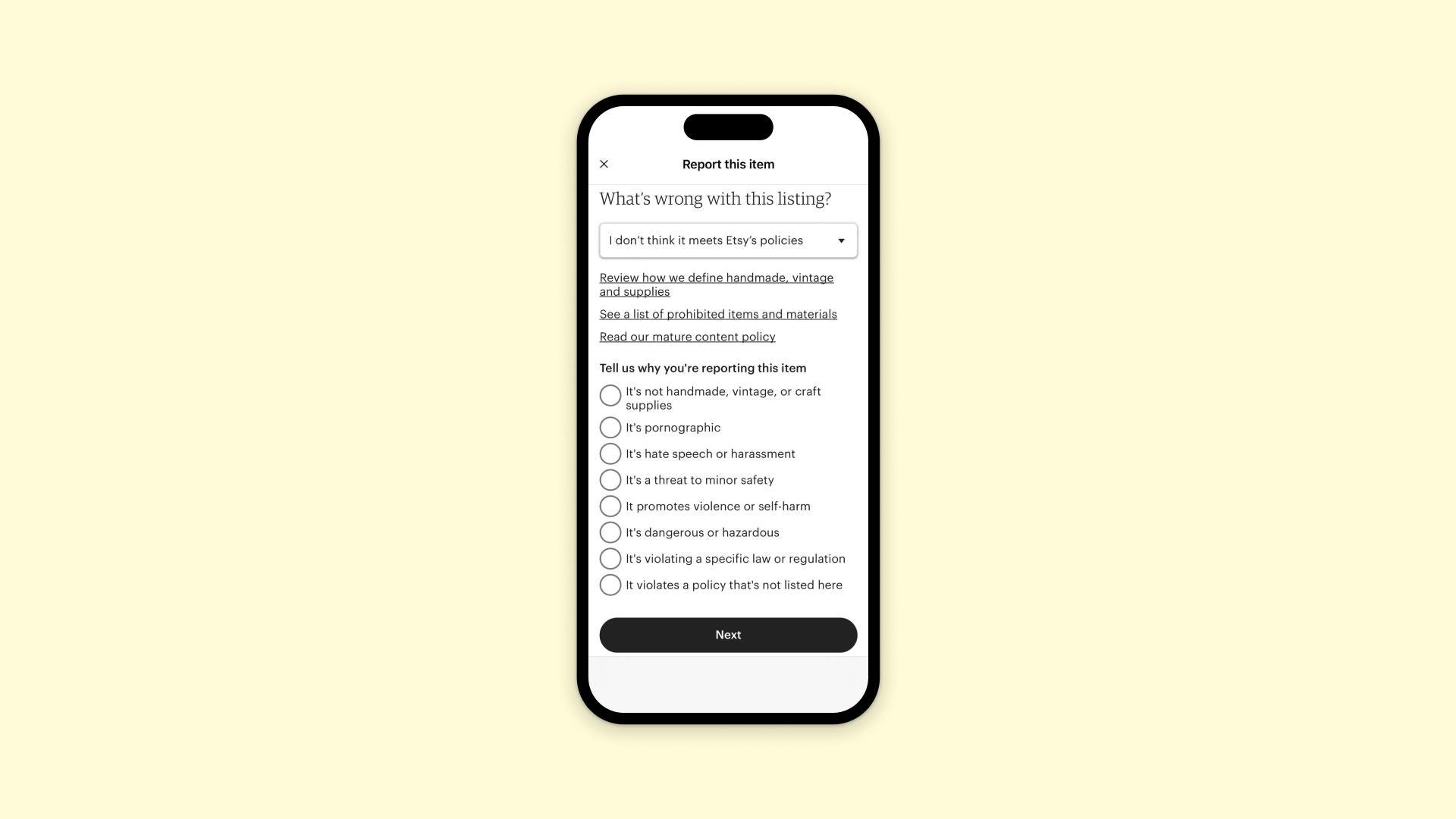
We strive to consistently enforce our policies and hold all members accountable to the same standards. Our goal is to strengthen trust in our community and maintain the integrity and authenticity of our platform.
Spotlight on Intellectual property
If intellectual property owners or their authorized agents consider something on Etsy to be infringing on their IP, they may report infringement to us, in accordance with Etsy’s policies, to request its removal. Our policies, which are based on case law, best practices, and the Digital Millennium Copyright Act (DMCA), require Etsy to remove any specified content when we receive a report of infringement that complies.
Etsy doesn’t pick and choose which items to remove for infringement. If a listing has been reported by an IP owner or their authorized agent, the seller will receive an automated IP infringement notice after the listing has been deactivated. To learn more, read 5 Common Questions About Intellectual Property on Etsy.
Looking forward
We’re dedicated to staying informed and responsive to the needs of our community, continuously reviewing our policies and processes in support of our mission to Keep Commerce Human. Through our shared commitment to keeping the marketplace safe and special, we’re able to connect buyers from around the world with your unique items, and build confidence that they’ll have experience that keeps them coming back for years to come.
Hear from Etsy's Head of Trust & Safety and Senior Director of Policy for an in-depth look at how we craft policies, uphold integrity and keep our marketplace safe in this recording of our May 28, 2025 event.
Return to the Ultimate Guide to Etsy Policy
*2024 Etsy Transparency Report
Friendly disclaimer: If you list products for sale on Etsy, you must comply with all federal, state, and local legal requirements and Etsy policies applicable to those products and product listings. This article is for informational purposes only, is subject to change over time, and is not legal advice. It is not intended to create, and receipt of it does not constitute, a lawyer-client relationship. The authors, Etsy, Inc. and Etsy Ireland UC, disclaim all responsibility for any and all losses, damages, or causes of action that may arise or be connected with the use of or reliance on these materials. Please consult an attorney or legal expert if you have any questions.
 Words by Etsy Staff