Our mission is to Keep Commerce Human, and one way we do that is by ensuring human reviews play a key role in our policy enforcement. When you open a shop on Etsy, you agree to follow our Terms of Use, including our Seller Policy, which outlines what can be sold on Etsy and our customer service standards. Our policies aim to strike a balance between encouraging creative expression and safeguarding the trust and integrity of our marketplace. We expect every user to follow these policies to ensure that Etsy remains a marketplace where creativity and originality thrive, and so our entire community can feel safe buying and selling on Etsy.
Our Trust and Safety team is dedicated to detecting potential content violations and enforcing our policies when items or member accounts are flagged for violations. This includes actions like listing mass-produced or resold items that violate our Creativity Standards or attempting to sell items that we don’t allow under our Prohibited Items Policy.
We understand it can be surprising to hear from us about a policy violation when you think you're doing everything right. We’re constantly monitoring our marketplace, and we regularly reach out to sellers to get more information about their items to ensure they're allowed under our policies. We also have automated systems in place to protect the safety and security of the Etsy marketplace. These systems are monitored by Etsy employees and we’re always working to make them more accurate.
In this article, we’ll cover some of the policy areas that most frequently lead to listing removals, and clarify the actions you can take to avoid possible missteps.
Policy best practices
1. Ensure your items align with Etsy’s Creativity Standards and clearly communicate your role in bringing your items to the marketplace
2. Represent your items to buyers accurately
3. Get familiar with the basics of intellectual property rights
4. Present sensitive content with care
1. Ensure your items align with Etsy’s Creativity Standards and clearly communicate your role in bringing your items to the marketplace
Buyers and sellers consistently ask us to reinforce what we stand for and show why Etsy—and every item you sell—is different and special. Our Creativity Standards help ensure the items sold on Etsy align with our brand mission by connecting buyers with unique items made, designed, handpicked, or sourced by creative sellers around the world.
There are four categories of unique items that can be sold on Etsy, based on the seller’s role in bringing the item to the marketplace. The categories are:
- Made by a seller: Physical items crafted, altered, or assembled by a seller, by hand or using tools they own (e.g., a 3D printer or Cricut machine)
- Designed by a seller: Original designs by a seller (or seller-prompted AI art) offered as a digital download or produced/printed by a third-party
- Sourced by a seller: Items that enable buyer creativity, such as craft supplies, party decorations, and items buyers can personalize and print on demand
- Handpicked by a seller: Vintage items, items from nature, and certain collections of items selected/curated by a seller
You can find detailed definitions for each of these categories in our Creativity Standards.
We show buyers how your item is categorized when they're viewing your listing to help them more clearly understand your involvement while building confidence and trust. That’s why it’s more important than ever to accurately represent your items in order to meet buyers expectations.
Want to keep your shop compliant with these policies? Transparency is key. Be clear about your role and accurately represent the items you sell. While the requirements vary by category, there are a few best practices that can help prevent confusion resulting in policy flags.
Recommended actions:
- Maintain your shop’s about section. A complete about section lets shoppers know there's a real person behind your items and gives Etsy's Trust and Safety team insight into how you work, which can provide helpful details in the event of a flag or review of your shop. List all of your shop members (including yourself), and list any outside production partners you use. Add recent photos of you, your shop members, your creative process, and your workspace for increased transparency. Learn more about How to Craft a Killer About Section.
- Understand who qualifies as a production partner—and who doesn’t. On Etsy, a production partner is a third party who helps turn your original designs into physical products. Note: If you’re using production assistance, it’s important to share this information on any applicable listings. You can create and review your production partner profiles in the production partner manager, and also easily add them to relevant listings.
- Examples of qualifying production partners include: print-on-demand services, cut-and-sew manufacturers, contract manufacturers (companies that produce products according to your specifications) and specialized production services (services that perform specialized techniques on your designs). Review detailed definitions of qualifying production partners in the Help Center.
- Examples that do not qualify as productions partners include: yourself or a member of your shop, pets, materials suppliers, and limited assistance providers, defined as partners that helped with only one part of an item that was primarily made by you/your shop (e.g., the workshop that fired your handmade ceramic mug, or an engraver that added text to your handmade jewelry).
- Tap into ethical supply chain resources. We’re proud to have a network of sellers, corporate suppliers, and partners doing business with Etsy who share our commitment to protecting fundamental human rights. When you work with a production partner, we want to help you make informed choices—and that means helping you determine if the businesses you collaborate with comply with all applicable laws, including safety, labor, and employment laws.
- Our Ethical Expectations policy outlines what we expect from sellers who work with production partners.
- You can also review our Supply Chain Resources for Sellers for education to support sellers in choosing ethical and responsible production partners.
2. Represent your items to buyers accurately
When a buyer receives an item that doesn’t meet their expectations, they can lose trust in your business—and Etsy. For example, we see this frequently when sellers are using a digital mock up of an item provided by a third-party production partner instead of using photography to showcase the actual item for sale. Marketing your item accurately through your listing images and description gives shoppers a clear picture about the product they’ll receive, helping to deliver on their expectations and ensure a positive experience.
Recommended action:
-
Build trust with accurate listing photos. Listing photos play an important role in providing transparency and building trust with buyers. We recommend using your first image or video to show the actual physical item the buyer will receive—not a rendering or stock photo.
When listing personalized or custom items such as monogrammed or engraved accessories, your first image must show a finished, customized item rather than the blank product or placeholder text (e.g. “Your Text Here”). Additional listing images may contain mock ups provided by production partners. Learn more about listing image requirements.
3. Get familiar with the basics of intellectual property rights
Intellectual property (IP) is a type of property for which creators and makers have certain ownership rights. Different intellectual property terms like copyright, trademark, and patent mean different things, and one item can have multiple types of IP.
It may be tempting to include names of popular brands or celebrities in your listing titles, tags or descriptions—for instance, the name of a luxury handbag company that inspired your purse design. But using that brand’s name in your tags may be considered problematic by some IP owners. Similarly, just tacking on “inspired by” or “____-like” in the tags or description may not prevent you from receiving a notice of infringement from the IP owner for a number of legal reasons, such as causing confusion. The same goes for any items that were “inspired by” popular books, movies or television shows.
If a listing has been reported by an IP owner or their authorized agent, the seller will receive an automated IP infringement notice after the listing has been deactivated. The automated email you received should outline which listings were removed at the request of the intellectual property owner (or an agent authorized by them).
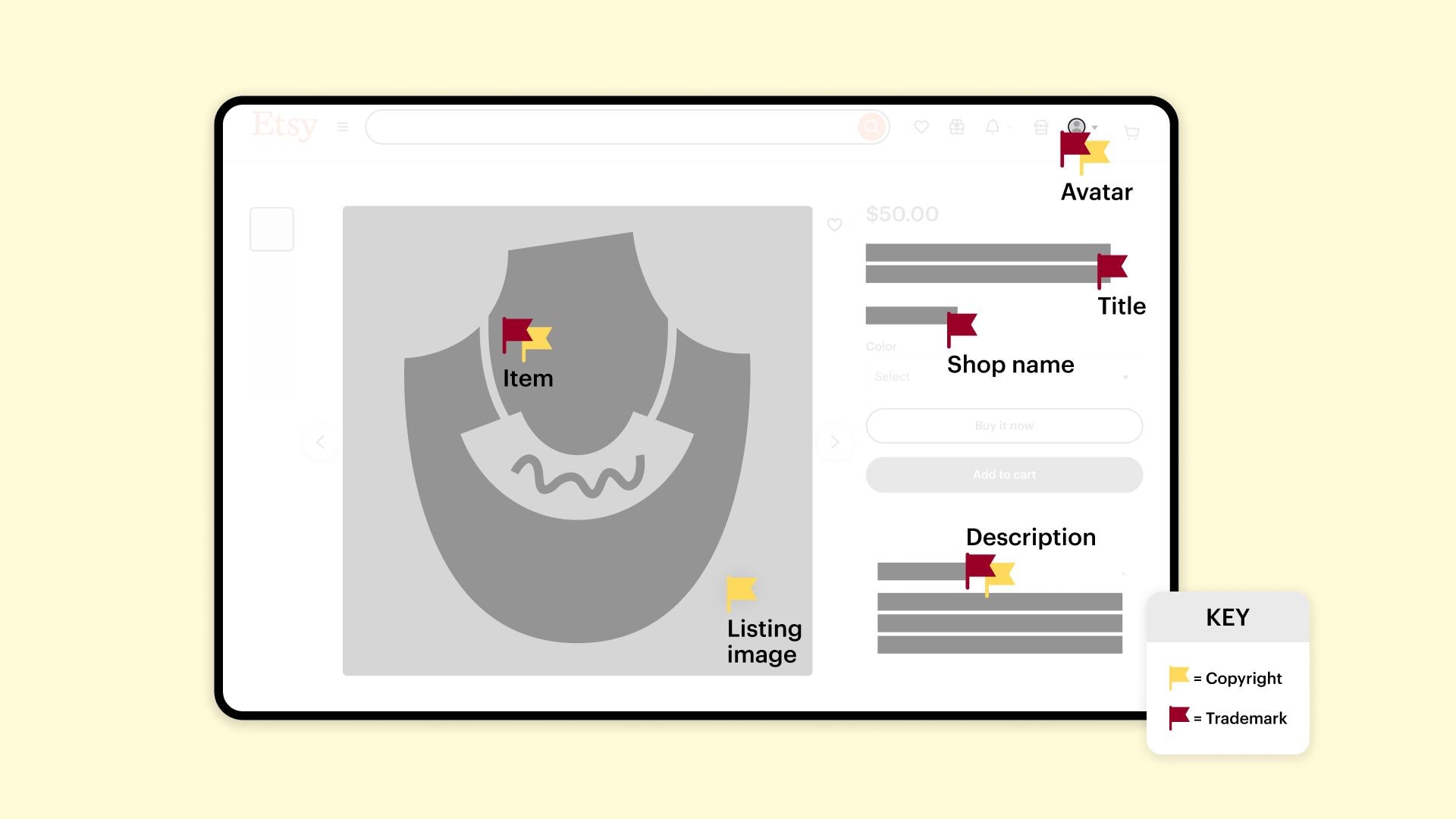
Many sellers express concern that a competitor has reported them. However, we don’t accept reports of infringement by just anybody—only from the intellectual property owner or the owner’s authorized agent (referred to here as the "complaining party").
We also require that the complaining party provide statements of good faith made under the penalty of perjury. There could be costly penalties if a complaining party makes material misrepresentations about the infringement. These claims are very serious matters.
Recommended actions:
- Respect the IP of others. There are a variety of public databases available to research existing IP ownership before publishing your listings, including the US Trademark Database, US Copyright Database, and the EU Intellectual Property Office e-commerce resource page.
- Understand your IP rights. It’s essential to know your rights and know what resources are available. The world of intellectual property can be murky and confusing. What you may consider “copying” potentially covers a wide range of activity that may or may not be infringement. For example, someone creating an item that looks a bit like yours is different from someone using your trademarked name in a misleading way, or posting a photograph you took without your permission. Please consult an attorney or legal expert if you have any questions.
- Resolve IP issues prior to relisting the item. We encourage you to directly contact the party that provided the report to Etsy if you have questions about the infringement claim, why your content was identified as allegedly infringing, or how to resolve the issue. You can also consider speaking to an attorney. Don’t create additional listings for this content unless the issue is resolved with the other party. Repeat reports of infringement may result in the loss of account privileges.
- Register your brand. If you’re a registered Intellectual Property owner, visit the Etsy Reporting Portal to create a profile and report listings that you suspect may violate your intellectual property rights. Read 5 Common Questions About Intellectual Property on Etsy to learn more.
4. Present sensitive content with care
Just like a classical art exhibit features paintings or statues that depict the human form, there are creative and artistic items sold on Etsy that may include potentially sensitive subject matter.
These items can be flagged when the listing doesn’t follow our policy requirements, which are designed to help safeguard our global community from unsolicited or unexpected exposure to mature content.
Etsy has long had policies in place that prohibit certain mature content and provide guidance on how to appropriately list adult items. Our Adult Nudity and Sexual Content policy details the types of adult nudity and sexual content that are allowed, and what is prohibited on Etsy. Please note that we have a separate, strict policy governing Imagery of Minors.
This policy enables creative expression and the spirit of our marketplace, while taking into account industry standards and best practices that keep our users safe.
Recommended actions:
- Obscure the thumbnail listing image appropriately. When listing an item that has mature content, the first thumbnail image in your item listing should be adequately obscured. Additional images in the listing may show the item in its entirety.
- Tag the item as “mature”. Listings containing mature content must also be tagged with the word "mature".
- Remove mature content from the public areas. Mature content—including permitted nudity and permitted sexual content—may not appear in the public areas of your account, including but not limited to your shop home, username, or avatar.
Learn more about Listing Mature Content Correctly in our House Rules.
Next steps
While these are four of the most common reasons our team sees flags in their day-to-day work, it's important for all sellers to take the time to review and understand all of Etsy’s policies. Doing so helps ensure your shop is set up for long-term success and reduces the risk of unintended hiccups. Staying informed and proactive not only protects your business—it also supports the integrity of the marketplace as a whole, helping Etsy remain a trusted, creative space for buyers and sellers around the world.
Return to the Ultimate Guide to Etsy Policy
Friendly disclaimer: If you list products for sale on Etsy, you must comply with all federal, state, and local legal requirements and Etsy policies applicable to those products and product listings. This article is for informational purposes only, is subject to change over time, and is not legal advice. It is not intended to create, and receipt of it does not constitute, a lawyer-client relationship. The authors, Etsy, Inc. and Etsy Ireland UC, disclaim all responsibility for any and all losses, damages, or causes of action that may arise or be connected with the use of or reliance on these materials. Please consult an attorney or legal expert if you have any questions.
 Words by Etsy Staff