Editor's note: This article was originally published in the Etsy News Blog on Feb 7, 2013.
Since we first started trying to get a handle on our carbon footprint a couple of years ago, Etsy has quadrupled in staff size, steadily expanded our main office space, and opened some new locations in the US and abroad. We've learned a lot more about what we need to look at to get an accurate assessment of our ecological impact, but we've also had to recognize that we're a moving target. Any piece of data we collect has to be understood in the context of our changing headcount and total occupied square footage. It's difficult to assess a growing company — even more difficult to assess one that is growing rapidly. Our earliest attempts had us sorting through electricity bills, looking at seasonal trends and equating kilowatt hours consumed in our Brooklyn office with an amount of CO2 emitted into the atmosphere. This was a worthwhile exercise, but in hindsight it was woefully incomplete in terms of a real effort to understand the environmental impact of our company's operations.
This past spring, after Etsy narrowly made the cut to become a certified B Corp, we held our own internal “Hack Day” devoted to projects that might help us better understand and address our deficiencies. During the Hack Day, employees took time away from their regular jobs to team up and work on initiatives that would improve our B Corp score. In the B Corp Environmental category, we definitely had a lot of room for improvement, and employees came up with an abundance of interesting ideas. One of the favorite Hack Day projects presented was the concept for creating a carbon tracker tool to help us visualize our carbon footprint. The idea was to come up with a way to make this information visible within the company and eventually to share it with our community. A dedicated bunch of Etsy employees gathered utilities data from our Brooklyn, Hudson and Berlin offices and put together some initial visualizations that allowed us to compare electrical usage across locations. We also began to incorporate numbers from our local composting efforts. It felt like we were getting somewhere. What we quickly realized, however, was that even this seemingly tiny step took a hell of a lot of work. We needed dedicated time and resources to gather data and guidance on putting some sturdy, reliable processes in place. Were we asking the right questions? Were we collecting the right data? Were we missing some things entirely? We decided to reach out for advice.
Friends at the NRDC directed us to Closed Loop Advisors, a small data-driven consulting group who embraced our desire to come up with some hard numbers while approaching the assessment of our operations in a holistic and transparent manner. We wanted to report our findings according to international standards but also to use our baseline operational assessment as the foundation of a proper sustainability strategy for Etsy — something we had never done before! We needed some concrete data, and we needed a context within which to understand it in order to start sharing it more broadly and setting real goals for ourselves as a company.
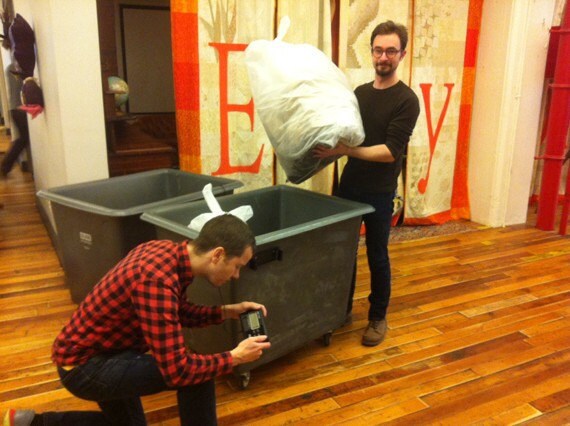
Fast-forward to the present: we've mostly completed a baseline assessment treating the operations of our Brooklyn, Hudson and Berlin offices as well as our New Jersey data center. Fun fact: the data center accounts for 80% of our total electricity. Wow. For certain slices of information, like office electricity, we have data going back a year or more. For shared utilities like heat and water, we have made estimates and are seeking more direct access to meters, dedicated accounts and more sophisticated ways of automating our data collection going forward. On the DIY measurement front, Closed Loop has helped us set up processes for collecting and weighing our landfill waste, e-waste, recycling and compost at all office locations. We now have about three months of data, and the whole pie so far looks something like this:

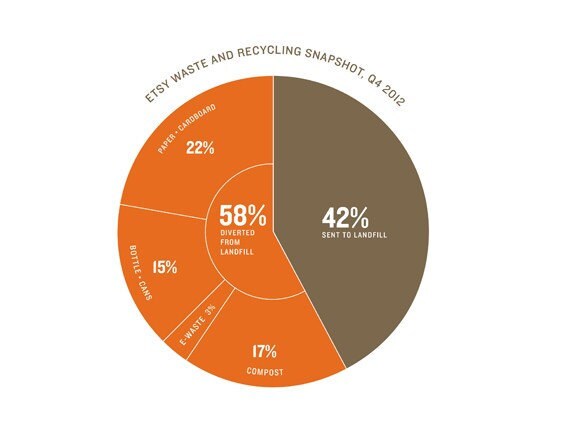
Having real numbers around the waste, recycling and compost we generate at Etsy will allow us to run experiments, create prototypes, and measure and improve ourselves in a strategic manner. There will be some obvious things that we can do immediately, and there will also be some more complex problems that require collaboration with building managers, commercial haulers, vendors, and engaged members of our communities. But this is an example of a first step into strategic sustainability management. There will inevitably be some outlandish ideas and hijinx along the way, and yes we're still working to realize our original goal of creating a tool to help us visualize our carbon footprint. Our imperative is to improve Etsy a little bit every day, even as we grow larger, and to create a positive impact in the buildings, the neighborhoods, and business communities where we operate. And crucially, we want to share our victories and failures with you so that you might benefit from our discoveries, our successes and our mistakes. We hope you'll share your own insights with us as well in this collective effort to bring our businesses into harmony with the delicate ecosystems that support us all. Stay tuned, and thank you!
